



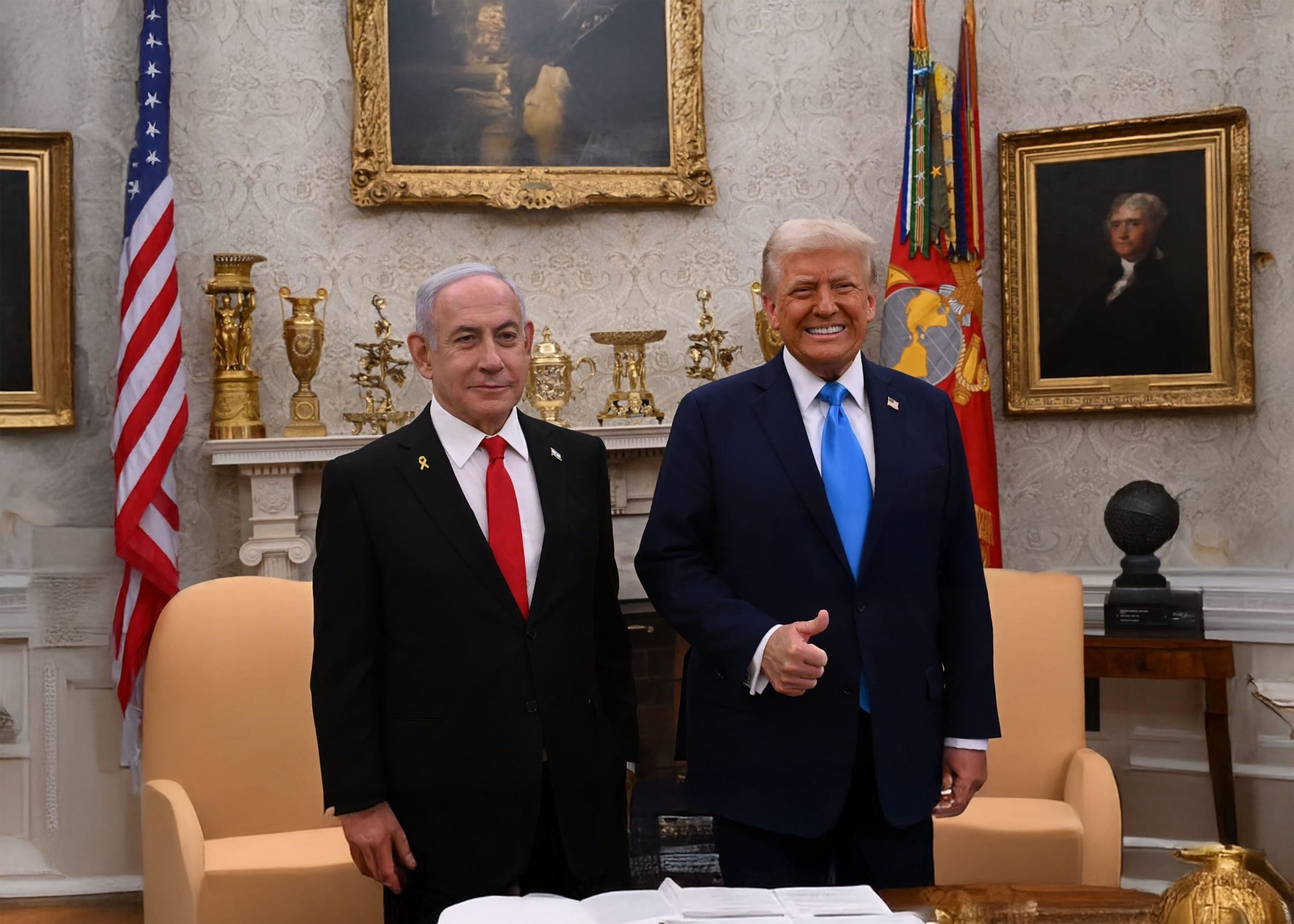
US President Donald Trump and Israeli Prime Minister Benjamin Netanyahu announced a sweeping new proposal on 29 September to address the Gaza conflict.
Trump’s 20-point plan emerged after weeks of talks involving key Arab and Muslim nations, including Egypt, Qatar, and Turkey.
Officials said the Israeli airstrike on Doha, which violated Qatar’s airspace in an attempt to kill Hamas negotiators, prompted Trump to pressure Israel into halting the war.
Freed from domestic constraints in his second term, Trump believed Israel had already achieved its primary military goals in Iran, Lebanon, and Gaza.
On 8 October, Trump confirmed that Israel and Hamas had signed the first phase of the agreement, marking the initial step toward peace.
Phase One: Ceasefire and Humanitarian Relief
The first stage of the plan orders an immediate ceasefire, freezing all military operations and frontlines.
Both sides must release hostages and prisoners within 72 hours. Israel will free 250 prisoners serving life sentences and 1,700 Palestinians detained since the conflict began.
In return, Hamas will release every Israeli hostage, both living and deceased, allowing for their return to Israel.
The agreement also demands full access for humanitarian groups to Gaza, ensuring that aid reaches civilians without interference.
Trump’s administration views this phase as the foundation for trust-building between Israel and Hamas before broader negotiations proceed.
The United States, Egypt, and Qatar will coordinate logistics, while the Red Crescent will oversee safe passage for aid workers and civilians displaced by fighting.
Phase Two: Disarmament and Security Transition
Once the hostages are freed, phase two will begin with comprehensive demilitarisation of Gaza.
The plan calls for the destruction of Hamas’s tunnels, weapons stockpiles, and military bases to prevent renewed hostilities.
Gaza will become a “terror-free zone,” as stated in Trump’s briefing, ensuring it poses no threat to neighbouring states.
Hamas members who renounce violence and accept peaceful coexistence will receive amnesty and may choose safe exile.
A multinational stabilisation force — including personnel from the United States, Europe, and the Arab world — will deploy to Gaza to enforce order and train a Palestinian police force.
Trump described this step as crucial to preventing power vacuums and maintaining peace across the region.
Security experts believe the presence of international forces could deter renewed aggression while ensuring accountability from all parties.
Phase Three: Reconstruction and Political Reform
The third stage of the plan envisions rebuilding Gaza’s governance under a neutral, technocratic Palestinian administration.
This transitional government will manage infrastructure repair, oversee public services, and cooperate with international organisations such as the United Nations and Red Crescent.
The “Board of Peace,” chaired by Trump and including global figures like former UK Prime Minister Tony Blair, will supervise reconstruction and governance.
International aid will flow freely into Gaza to restore schools, hospitals, and utilities destroyed during the war.
The United States and allied donors will fund major reconstruction efforts to stabilise the economy and encourage Palestinians to remain and rebuild their communities.
The plan acknowledges Palestinian statehood as an aspiration tied to successful reforms and reconstruction but stops short of promising US recognition.
Trump’s team argues that Palestinian self-governance must first prove stable, transparent, and free from extremist influence.
Netanyahu, however, rejected the idea of a Palestinian state under this plan, stating that Israel will maintain security control to prevent future threats.
Despite uncertainty about long-term outcomes, the plan represents the most ambitious attempt yet to end the two-year Gaza war and reshape regional dynamics.
